
Programs


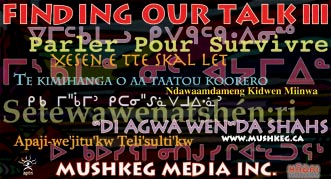
Finding Our Talk: A Journey into Indigenous Languages - Season Three
Length: 13 x 30 min. (documentary series)
Release: 2009
Original Version: English
Series directors: Tracey Deer, Paul Rickard, Jeff Dorn, Josephine Bacon, Paul Chaput, Michelle Smith, Jeff Barnaby and Reaghan Tarbell
Every fourteen days a language dies. By the year 2100 more than half of the world's languages will disappear. These are tough statistics, but it doesn't have to be that way. Indigenous people everywhere are fighting to beat the odds. It's a remarkable story. We’re discovering and sharing their successes by focusing on and celebrating the many individuals, communities and organizations that are reclaiming their language, and along with it, their culture, their stories and often, their very existence as a people.
The third season of Finding Our Talk 3 looks at innovative programs with an international perspective that includes episodes shot in Canada, the United States, New Zealand, Australia and Latin and South America.
Finding Our Talk 3 is produced by Mushkeg Media Inc. in association with APTN, the Aboriginal Peoples Television Network. We are also working in conjunction with Maori TV for a Maori version of the series. Mushkeg Media is an aboriginal owned production company with a solid track record that provides comprehensive mentorship and training to Aboriginal filmmakers as part of the production process.
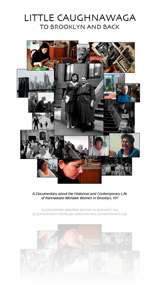
Little Caughnawaga: To Brooklyn and Back
Length: 48 min. (documentary)
Release: 2008
Original Version: English
Other Versions: French and Mohawk versions
Director/Writer: Reaghan Tarbell
Producers: Paul M Rickard and George Hargrave
Produced by: Mushkeg Media Inc. and the NFB in association with APTN
Purchase: Home and public viewing versions available for purchase through the NFB. US residents can purchase the film through VisionMaker.
Little Caughnawaga: To Brooklyn and Back is an hour-long documentary about the personal story of Mohawk filmmaker Reaghan Tarbell from Kahnawake, Quebec, as she explores her roots and traces the connections of her family to the Mohawk community in Brooklyn, New York.
For over 50 years, the Kahnawake Mohawks, of Quebec, Canada occupied a 10 square block area in the North Gowanus section of Brooklyn, which became known as Little Caughnawaga. The men, skilled ironworkers, came to New York in search of work and brought their wives, children and often, extended family with them. The story of the Mohawk ironworkers is an important one and is one that has been told and continues to be told through documentaries, newspaper and magazine articles. Yet the stories of Kahnawake Mohawk women who lived in Brooklyn have gone untold.
Comments:
"I grew up at 375 State St in the 50s-60s, one of a few non-Mohawks in the building and neighborhood. I really want to tell you how much I am relishing the film: I am learning so much about my own neighbors and neighborhood that I, sadly, did not know being outside the culture. E.g. I was surprised to learn of the Cuyler Church, as most of my Mohawk friends were Catholic and devotedly attended St. Charles Borrommeo RC Church. Likewise, I did not have a sense of when the community had begun or why. I just wanted to tell you how personally your film touched me. The names and voices are all so familiar. Terrific job and congratulations on your accomplishment. And thank you!" - L. Lavora
"A small anecdote about these Indians is that I am a Brooklyn native and as young men my friends and I would often have drinks at the Doray Tavern which is on Atlantic Ave. The sign on the wall on the outside of the bar said, 'where good friends meet.' This was a real dive bar but we were underage and they would serve us. In 1976 we drove up to Montreal to try and see the Olympics but we were unable to see any of the events but we found ourselves one evening at a Knights of Columbus outside of Montreal where we met this tribe of Indians who were drinking at the same establishment we were jokingly referring to the K of C as the Doray north when one of the Tribesman spoke up and said, 'where good friends meet'. You could imagine our shock when we found this community of people who knew our turf better than we did, they knew every bar, store and restaurant in town. Since we were long lost Brooklyn brothers and Doray drinkers in good standing we were taken to a lacrosse game that we were told their team always won or the other team would have to fight their way out of the long house. They shared their homes, their food. Your story was great, thanks for sharing it brought back a great story and a little bit of history for me." P. Infante
KANIEN'KEHÁ:KA: Living The Language


A 2-part documentary in Mohawk with English and French versions
Length: 2 x 48 min
Release: 2008
Original Language: Mohawk
Other Versions: English and French
Producers: Paul M. Rickard and George Hargrave
Produced by: Mushkeg Productions Inc. in association with APTN (Aboriginal Peoples Television Network)
Kanien’kehá:ka - Living the Language is a two part documentary about the personal, thought provoking and honest stories of the Mohawk language (Kanien’kehá:ka) immersion program in Akwesasne. It examines various aspects of what it takes to learn and maintain a language through immersion by addressing key concepts of tradition, traditional education and identity preservation.
In the late 1970’s, the Mohawk community of Akwesasne began a dynamic language revitalization movement. The establishment of Mohawk language immersion programs and the creation of the Akwesasne Freedom School were just two of the major aspects of the movement. “One cannot be traditional without knowing and speaking Kanien’kehá:ka (the Mohawk language)” is often heard at the school. Parents and elders operate the Freedom School by a consensus decision-making process with financial support primarily from annual quilt sales and potluck dinners.
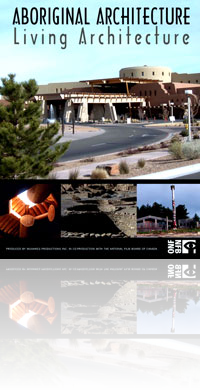
Aboriginal Architechture – Living Architechture


Length: 90 min.
Release: 2005
Format: DV Cam Widescreen 16:9
Director: Paul M. Rickard
Producers: Paul M. Rickard and George Hargrave
Co-produced: the National Film Board of Canada and Mushkeg Productions Inc in association with APTN
Writers: Paul M. Rickard and Janice Benthin
Broadcasters: Aboriginal Peoples Television Network and Saskatchewan Community Network
Aboriginal Architechture – Living Architechture is a documentary that explores the way Aboriginal architecture reflects the diversity of environments and Aboriginal cultures across North America.
Everyone is familiar with certain types of Aboriginal architecture. Traditional igloos and tepees are two of the most enduring symbols of North America itself. But how much do we really know about the types of structures Native peoples designed, engineered and built to house their lives? For more than three hundred years, native communities in North America have had virtually no indigenous architecture. Communities have made do with low cost government housing and community projects designed by strangers in far away places.
Finding Our Talk - Season One
Length: 13 x 30 min (4 different languages total of 52 half hours of programming)
Release: 2001
language versions: Cree, Mohawk, English and French
More info>>
Finding Our Talk - Season Two
Length: 13 x 30 min (4 different languages total of 52 half hours of programming)
Release: 2002
language versions: Cree, Mohawk, English and French
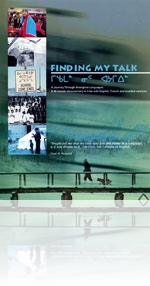
Finding My Talk: A Journey into Aboriginal Languages

Length: 48 min.
Release: 2000
Producers: Paul M. Rickard (Cree), George Hargrave and Janice Benthin
Director/Writer: Paul M. Rickard (Cree)
Produced: Achimist Films Inc. and Nutaaq Media Inc.
Produced for: Aboriginal Peoples Television Network
In association with the Kativik School Board, Wawatay Native Communication Society and the Inuit Broadcasting.
A filmmaker looks at his Cree language roots and presents the work Native people across Canada are doing to revive and preserve First Nations languages.
This one hour documentary follows the journey of Cree filmmaker Paul M. Rickard as he searches for his own language roots and discovers the tireless efforts of many individuals who are promoting, reviving and preserving the use of Aboriginal languages within their communities.
He visits Carcross in the Yukon where the Tlingit language is one of the most endangered languages in Canada. From there he travels to Kahnawake, Quebec where the Mohawk have been conducting special language programs since 1977. His journey also takes him to Iqaluit where Inuktitut is thriving as the official language of the government of Nunavut. In each place he meets dynamic people who are leaders in the struggle to save their languages. Revitalized by these experiences,Paul returns home to Moose Factory, Ontario with a new appreciation for his own language.
The Winter Chill
Length: 24 min. 50 sec.
Release: 2006
Director: Paul M. Rickard
Producers: Paul M. Rickard (Cree) and Daniele Rohrbach
Actors: Dakota House (Cree) and Glen Gould (Mi'gmaq)
Version: English
The Winter Chill is a short drama that follows a young Cree man into the bush where he is reluctantly tending his father’s trapline only to run headlong into the legendary Cree creature, Pakaaskokan. At first terrified, he is shocked to learn that there was far more in his father’s stories than he ever dared realize.
The Winter Chill is an adaptation and modern retelling of a traditional Cree narrative about the filmmaker's grandfather who one winter encountered the ancient emaciated being Pakaaskokan while out in the bush checking his traps. Paul first heard the story a few years ago from his father Frederick Rickard Sr. who originally heard it from his own mother. It's a story passed down from one generation to another and now it’s Paul's turn to pass it along in the form of a short film.
Shot on location in Moose Factory, Ontario, Canada, “The Winter Chill” was written and directed by Cree filmmaker, Paul M. Rickard as his first dramatic film. Starring Dakota House as Simon and Glen Gould as Dan with Ernest Webb as the Voice of Pakaaskokan.